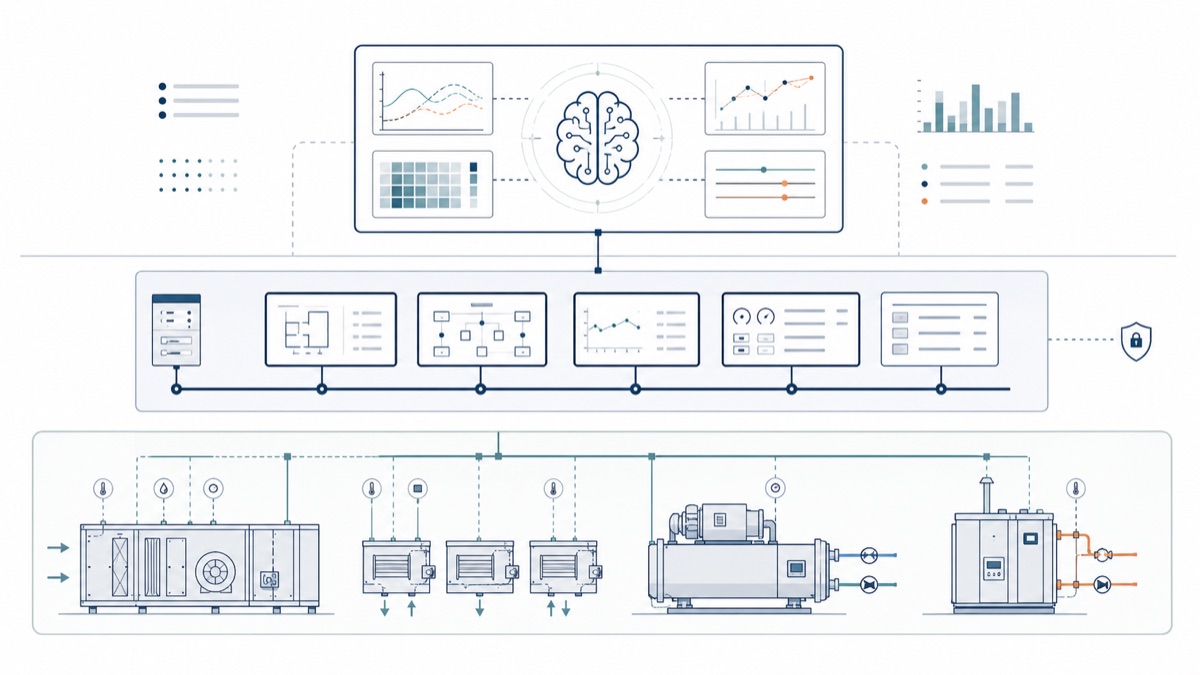
BMSBuilding management system: the supervisory controls and dashboards that coordinate HVAC setpoints and sequencing. supervisory AI is an optimization layer above the existing building management system. ClimaMind optimizes bounded supervisory targets while the BMSBuilding management system: the supervisory controls and dashboards that coordinate HVAC setpoints and sequencing. remains in charge of safe execution. The AI can recommend or write approved setpoint changes, but the native BMSBuilding management system: the supervisory controls and dashboards that coordinate HVAC setpoints and sequencing. still owns local loops, equipment safeties, alarms, operator graphics, manual override, and fallback behavior.
ClimaMind is built for sites that already operate through Niagara, EcoStruxure, i-Vu, DESIGO CC, or similar BMSBuilding management system: the supervisory controls and dashboards that coordinate HVAC setpoints and sequencing. environments. The AI layer adds coordination without turning the project into a controls replacement or bypassing the safety measures already used by the facility team.
A modern BMSBuilding management system: the supervisory controls and dashboards that coordinate HVAC setpoints and sequencing. is already a layered control system. Equipment controllers protect chillers, boilers, pumps, fans, drives, pressure, flow, freeze conditions, and service lockouts. Local DDC logic runs PID loops, dampers, valves, fan speed, pump speed, economizers, interlocks, schedules, and minimum runtime rules. ClimaMind sits above those layers, where schedules, reset strategies, staging preferences, and approved setpoint bands can be optimized.
The diagram should be read from bottom to top. The physical equipment remains at the bottom, the existing BMSBuilding management system: the supervisory controls and dashboards that coordinate HVAC setpoints and sequencing. and local controllers remain in the middle, and the AI layer sits above them as a supervisory decision layer. That placement matters because the AI is not drawn as a replacement controller inside the plant; it is drawn as a source of better operating intent that still passes through the site control structure.
In practice, this means ClimaMind first learns from the same evidence the facilities team already trusts: equipment status, loop temperatures, valve and damper positions, fan and pump behavior, weather, occupancy signals, comfort state, and energy use. The output is not a raw command to a motor or compressor. The output is a bounded target that the BMSBuilding management system: the supervisory controls and dashboards that coordinate HVAC setpoints and sequencing. can accept, reject, limit, or execute through its existing sequence.
This is why the architecture is safer than a bypass. If the supervisory layer is unavailable, stale, manually paused, or rejected by the BMSBuilding management system: the supervisory controls and dashboards that coordinate HVAC setpoints and sequencing., the plant does not need a new emergency behavior. It continues under the native control strategy that was already operating the building.
Control boundary
Bounded targets, unchanged device safeties
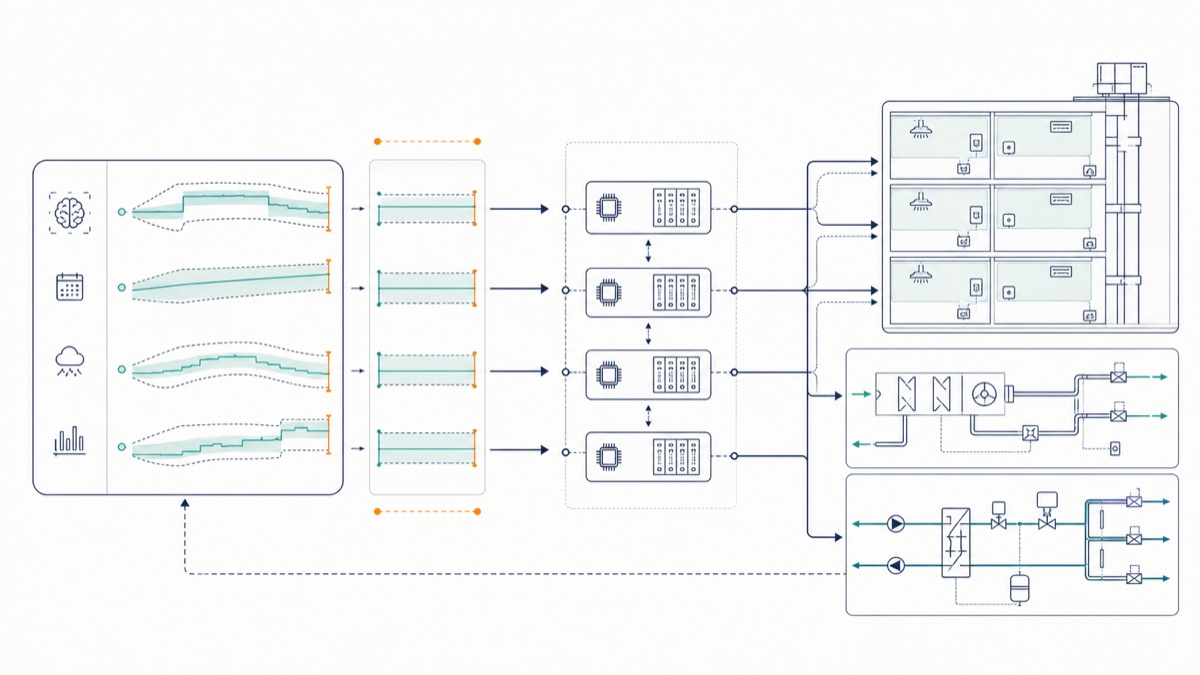
ClimaMind does not need direct device-level authority to reduce HVAC energy use. Instead of commanding compressors, burners, pumps, fans, valves, or dampers, it recommends bounded supervisory targets that the existing BMSBuilding management system: the supervisory controls and dashboards that coordinate HVAC setpoints and sequencing. executes through normal control sequences.
The second diagram is about authority, not just data flow. The AI can compute a better supply air temperature target, chilled water reset, duct static pressure target, zone band, staging preference, or demand response objective, but each of those targets is still a target inside an agreed operating envelope. The diagram shows those targets narrowing into the BMSBuilding management system: the supervisory controls and dashboards that coordinate HVAC setpoints and sequencing. path before they reach equipment.
That distinction is important for system integrators. A direct equipment override says, in effect, that the new software has become part of the device safety chain. A supervisory target says something different: the BMSBuilding management system: the supervisory controls and dashboards that coordinate HVAC setpoints and sequencing. is still responsible for translating intent into actuator behavior, applying rate limits, honoring modes, enforcing sequence conditions, and keeping local control loops stable.
The value comes from choosing better goals at the system level. For example, a static duct pressure or chilled water temperature may be safe but wasteful under many load conditions. ClimaMind can search for a better target while the BMSBuilding management system: the supervisory controls and dashboards that coordinate HVAC setpoints and sequencing. remains the executor that decides whether the target is valid for the current mode.
Non-bypassable
Non-bypassable BMS and equipment safeguards
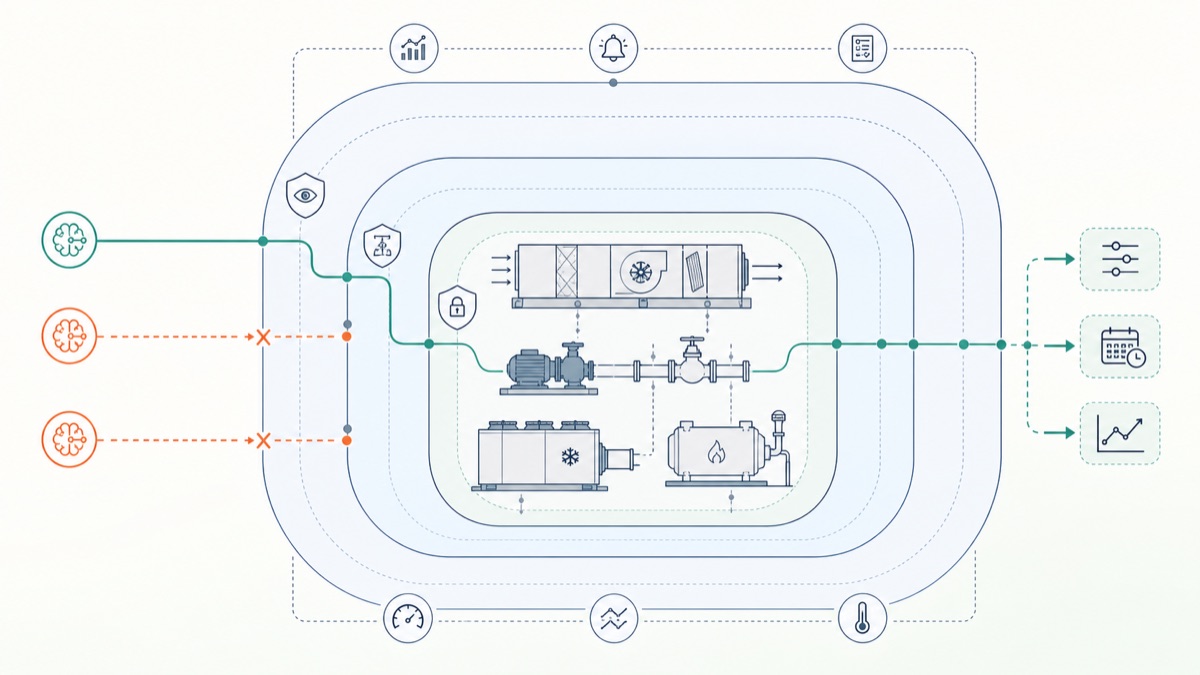
The point is not to ask customers to trust that AI will always be right. The point is to make sure the AI cannot directly cross the layers that already protect the building. Safe supervisory control makes those non-bypassable layers explicit.
The safety diagram is intentionally nested. The innermost layer is the equipment and its local controller. Around that sit BMSBuilding management system: the supervisory controls and dashboards that coordinate HVAC setpoints and sequencing. sequences, alarms, lockouts, minimum runtime rules, anti-short-cycle rules, flow and pressure protection, temperature limits, manual modes, and operator actions. The AI layer is outside those protections, so its proposal must pass through them before the building changes state.
A wrong AI recommendation should therefore behave like a bad setpoint request, not like a destructive command. It can be clipped by a limit, ignored in the wrong mode, blocked during an alarm, superseded by manual operation, or rolled back when the supervisory layer is paused. The design goal is not that the optimizer is never wrong; the design goal is that wrong optimizer output remains bounded by the control stack.
For a customer, this is the core safety argument. ClimaMind does not ask the site to remove safeties in order to save energy. It asks the site to expose a small set of supervisory variables whose normal BMSBuilding management system: the supervisory controls and dashboards that coordinate HVAC setpoints and sequencing. enforcement path already exists, then optimizes within that path.
Trust
Auditable safety with reversible control actions
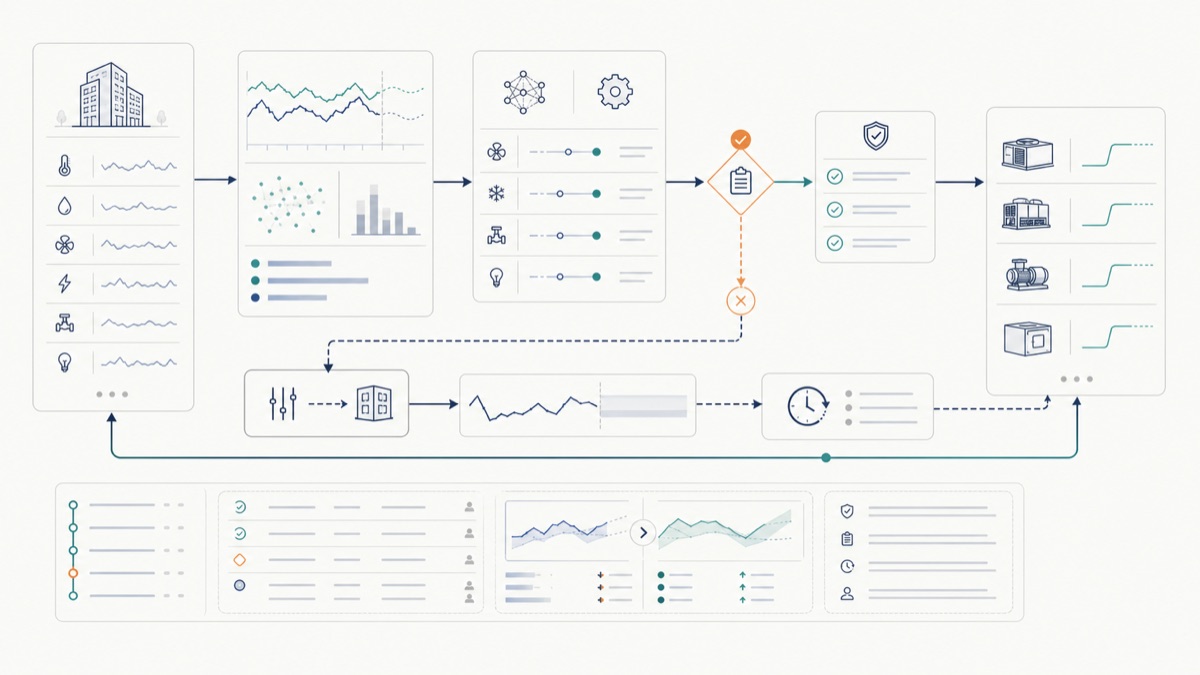
Customers can trust the architecture because optimization stays above the layers that already protect the building. ClimaMind actions are bounded, auditable, reversible, and routed through the existing BMSBuilding management system: the supervisory controls and dashboards that coordinate HVAC setpoints and sequencing. control structure. Bad recommendations should be rejected, limited, or rolled back; communication loss should leave the site in known BMSBuilding management system: the supervisory controls and dashboards that coordinate HVAC setpoints and sequencing. behavior.
The final diagram turns trust into an operating procedure. A recommendation is produced, evaluated against the approved envelope, passed through the BMSBuilding management system: the supervisory controls and dashboards that coordinate HVAC setpoints and sequencing. path only when it is valid, and recorded as an accepted, rejected, overridden, or automatically written action. The important point is that safety is not hidden inside an AI promise; it appears as an observable chain.
This is also how a pilot can become a production control path without asking the operator to take a leap of faith. The site can start in advisory mode, compare recommendations against operator judgment, narrow the writable point list, and only then enable automatic writes for specific supervisory variables. Each step leaves evidence that the facilities team and SI can inspect.
If the optimization layer is disconnected or paused, the same diagram shows the fallback. The BMSBuilding management system: the supervisory controls and dashboards that coordinate HVAC setpoints and sequencing. keeps its schedules, sequences, alarms, manual overrides, and default strategy. ClimaMind adds a smarter target layer, but the site keeps a known control authority underneath it.
Common questions
Direct answers for AI HVAC optimization research
These questions mirror the way owners, operators, and AI search systems evaluate whether a platform can control real HVAC equipment safely.
Can BMS supervisory AI damage HVAC equipment?
A safe deployment should prevent that failure mode by design. ClimaMind writes only approved supervisory targets, while equipment controllers and the BMSBuilding management system: the supervisory controls and dashboards that coordinate HVAC setpoints and sequencing. continue to enforce local loops, alarms, safeties, minimum runtime, flow, pressure, temperature, operator override, and fallback rules.
Can supervisory AI write to the BMS?
Yes, but only for approved points and within defined guardrails. Many deployments begin read-only or advisory before enabling automatic writes to supply air temperature reset, chilled water supply temperature reset, duct static pressure reset, or other approved supervisory points.
What happens if ClimaMind is offline or communication is interrupted?
The existing BMSBuilding management system: the supervisory controls and dashboards that coordinate HVAC setpoints and sequencing. remains the operating authority. Site schedules, sequences, alarms, manual overrides, and default strategy continue without needing ClimaMind to stay online. When the supervisory layer is unavailable, stale, paused, or rejected, the building should return to known BMSBuilding management system: the supervisory controls and dashboards that coordinate HVAC setpoints and sequencing. behavior rather than a new emergency mode.
How do operators override or pause ClimaMind supervisory control?
Operators keep authority through the same BMSBuilding management system: the supervisory controls and dashboards that coordinate HVAC setpoints and sequencing. and site procedures they already use. A facility team can pause optimization, reject a write, narrow the writable point list, switch equipment to manual or service mode, and review whether each action was accepted, rejected, overridden, or automatically written.
What happens if the AI layer is offline or rejected?
The site should fall back to the native BMSBuilding management system: the supervisory controls and dashboards that coordinate HVAC setpoints and sequencing. control path. ClimaMind is designed as an overlay, not a replacement for local control and safety logic, so offline, stale, rejected, manual, or alarm states remain bounded by the existing BMSBuilding management system: the supervisory controls and dashboards that coordinate HVAC setpoints and sequencing. behavior.
Reference basis
External standards and public references
These public references anchor the page's claims about building controls, supervisory sequences, and savings measurement.